

|
10
AI-generated personas—including fake soldiers, veterans, recruiters, and a rabbi—are flooding Ukrainian-language social media.
According to an analysis by Vantage, LetsData’s narrative threat detection platform, these synthetic personas pushed narratives attacking Ukraine’s military leadership as well as migrants, amassing more than 20 million views in the first half of 2026.
This is an operational shift; where influence operations once relied on one-off deepfakes, they now maintain a rotating cast of fabricated characters reused across publications and platforms. These personas are not meant to be realistic. Instead, their purpose is to reinforce narratives and create engagement.
What Vantage Found
Between January and May 2026, Vantage tracked more than 30 Assets producing AI-generated content across TikTok and Facebook in the Ukrainian-language information landscape. Vantage observed roughly 15,000 publications, totaling more than 20 million views, 20,000 shares, and 40,000 comments.
These Assets use recurring synthetic personas: soldiers, MPs, military recruitment officers, veterans, and religious figures. Each one is not a one-off character but an archetype deployed again and again.
A random video with a person complaining about corruption in the military is just another grievance in the feed. But when the same words come from a soldier inside the military, they carry more weight. When the same message comes from not one, but dozens of soldiers, the effect compounds regardless of whether the audience believes they’re watching a real person.
These synthetic personas no longer need to look convincing to work. Shaky footage, bad audio, and rough cuts are purposely used to make videos look more authentic, like a real person filming something on their phone in the field. Short-form platforms have made that aesthetic the norm, and synthetic content no longer needs to look polished to look credible.
The Soldier Persona
In May, the Asset Солдатська правда (Soldiers' Truth in Ukrainian, @soldiersuatruth) accumulated 1.6 million views across three Facebook publications — each delivered in the first person through the AI-generated archetype of a soldier:

"Two years away from home. What for? So politicians can build a third house on the Riviera?"
"The real draft dodgers are the recruitment officers themselves. Send them to the front and there'll be enough people."
"My commander is covered in medals. He's never been within 30 kilometers of the front."
The Asset doesn’t maintain one persona, but rather a synthetic archetype. The soldiers can have different faces and stories, but deliver the same narratives embedded in synthetic videos.
Another group of accounts—"Телемарахвон" (means "Telemarathon" in Ukrainian; the original title intentionally uses a misspelling for satirical effect, ua_telemarahvon), “Батальйон "Барбершоп"” (means "Barbershop Battalion" in Ukrainian, @barber.battalion.u), and “Шарова́ри LIVE ” (means "Sharovary LIVE" in Ukrainian; "Sharovary" refers to traditional Ukrainian Cossack-style trousers, @echo_ua_1)—use obviously exaggerated voices to convey sarcasm. In these videos, synthetic soldiers claim that MPs' children deserve exemption from mobilization because "there are still plenty of people on the streets" and that recruitment officers are "heroes" fighting the "internal enemy.” The exaggeration is the mechanism: provoke a reaction, and the algorithm handles the rest.
The Veteran Persona
The "Бидлогеть" Asset (means Boors, Begone in Ukrainian) follows a single template using different AI-generated persona each time, but always the same story: someone came back from the war and found there was nothing left for them. Trauma, state indifference, isolation, no future. In May, that looked like this:
A veteran in a wheelchair: "I've become a stranger even at home"
A child holding her father's hat, smelling it: "So dad will come back"
The specific person doesn't matter. What matters is the role they play and the emotion that role produces.
Anti-migrant narratives
The highest-reach narrative of May, with more than 15 million views in a single month, was built around three interlocking frames, each pushed separately through AI-generated content:
“Migration as the demographic replacement of Ukrainians dying at the front”
“Migrants as a threat to children's safety”
“Economic unfairness — migrants receiving housing and $450–550 a month while Ukrainians die in the war”
The biggest single spike came between May 7 and 10, when the Asset kent61310 published a series of AI-generated lip-sync videos showing President Zelensky and Kyiv Mayor Klitschko welcoming Indian migrants. It got more than 10 million combined views in four days, before the content was taken down.
The spread of this narrative through audio is worth examining separately. The AI-generated songs "Chuzhyi v Khati" ("A Stranger in the House") and "Aladiny" ("Aladdins") reached over 516 Assets, each one layering the tracks over its own visuals, mostly static images of Ukrainian soldiers, without producing any original content. Once a track enters circulation, TikTok's algorithm picks it up as a trending sound, and the anti-migrant lyrics get absorbed into an existing emotional register of wartime grief. Nobody had to build that register from scratch. They just plugged into it.
The Rabbi Persona
The “Беседы с ребе Гликманом” (means Talks with Reb Glickman in Ukrainian, @glickman_talks) Asset accumulated over 1.2 million views through an AI-generated rabbi persona. This is the most layered construction we documented.
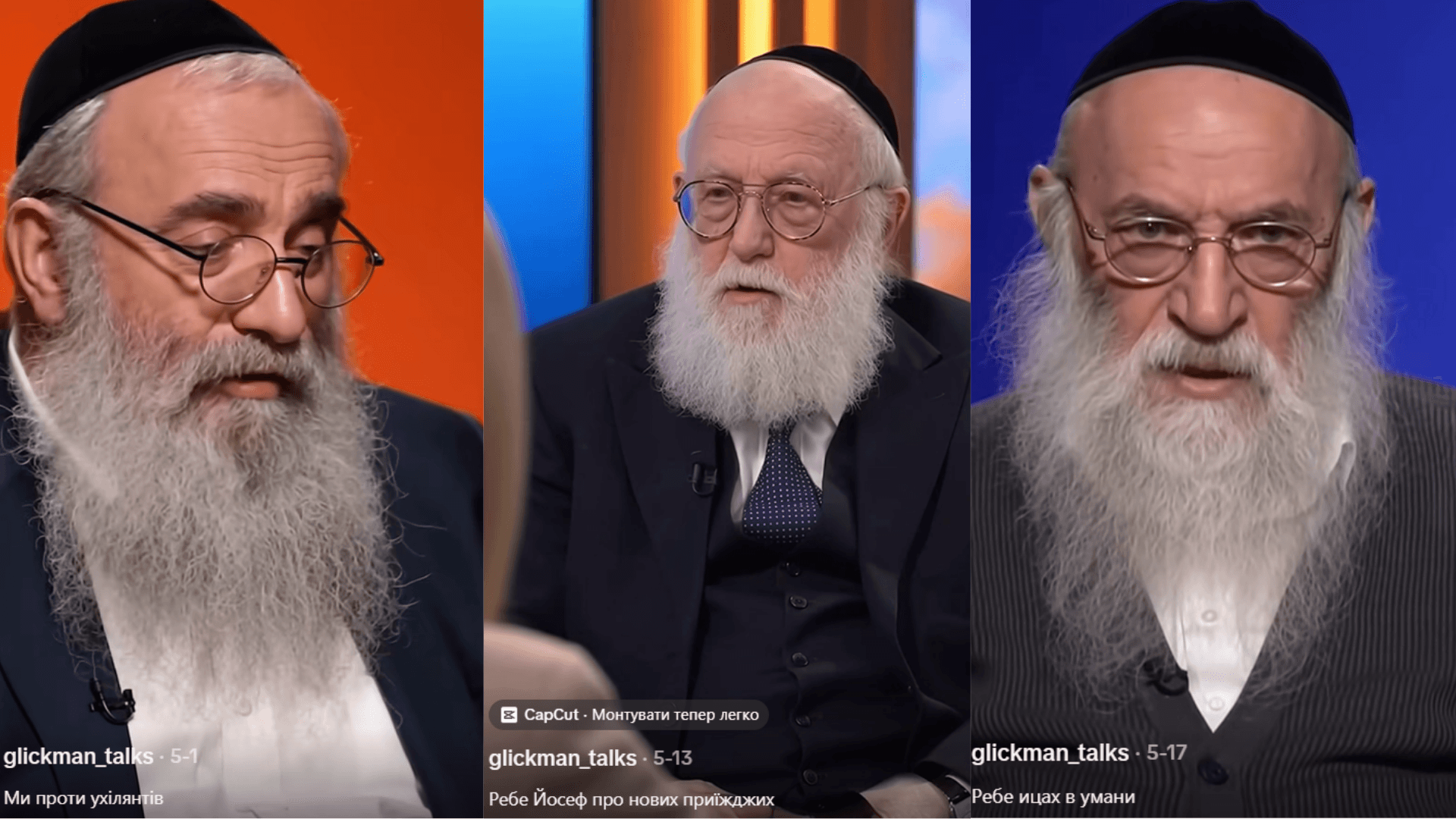
The persona supports migration for Ukraine broadly while opposing the presence of migrants in Uman, framing Jewish communities as people who open the door for others while keeping it closed for themselves. In doing so, it presents audiences with the idea that Jewish communities are lobbying Ukrainian migration policy in their own interests — a message that sits somewhere between anti-migration rhetoric and a conspiracy theory about hidden influence over state decisions.
Why Audiences Engage Even When They Know It's AI
People in the comment sections of this content frequently identify it as AI outright. They engage anyway. They defend the soldiers, go after the politicians, argue with each other about the substance. The algorithm doesn't distinguish between outrage and agreement. It sees interaction and distributes. "This is obviously fake" pushes a video just as effectively as support does. The goal of these operations was never to make someone believe a specific video. It was to produce a reaction that triggers the algorithm — anger, recognition, the urge to argue.
Why Taking Down Videos Won’t Stop AI-Generated Content From Spreading
TikTok has consistently taken down a share of the Assets we've identified. The "Телемарахвон" Assets (means "Telemarathon" in Ukrainian; the original title intentionally uses a misspelling for satirical effect, ua_telemarahvon) stopped posting on May 14, as TikTok banned the account. The "Бидлогеть" Assets (means Boors, Begone in Ukrainian) were banned on May 27. In both cases, the platform acted on the exact content we'd documented.
Banning an account doesn't mean the network disappears. The "Бидлогеть" mirror account on Facebook is still active as of July, even though its TikTok version is gone. More importantly, we're not seeing new accounts spun up to replace the banned ones. What we're seeing instead is repurposing: Assets with an existing history, an audience, and accumulated algorithmic trust simply pivot their thematic direction.
“Шарова́ри LIVE” (means "Sharovary LIVE" in Ukrainian; "Sharovary" refers to traditional Ukrainian Cossack-style trousers, @echo_ua_1) is the clearest example. The account has existed since 2025 and initially posted anti-Russian AI-generated content that mocked Russian soldiers and pushed stories about looting during the occupation. The format later shifted toward fake polls purporting to be from Russians in the same mocking, exposé-style tone. But from late April 2026, the account changed register entirely, switching to content built around exaggerated MPs and military figures delivering deliberately provocative lines.
This isn't the same as simply standing up a new account to replace a deleted one. An account with a publication history and an existing audience is worth more than a blank profile with no track record, so it's easier to repurpose than to abandon. That also makes this harder to catch: monitoring that only watches for newly created suspicious accounts will miss an established one quietly changing lanes.
Why synthetic personas are so hard to combat—and what we can do about it
Detection tools are typically tuned to catch individual fake videos or individual accounts, but this approach misses repeat offenders.
Debunking, too, isn’t very effective. Since AI-generated influence campaigns generally exploit real issues and grievances, fact-checking can often be read as dismissing the underlying issue, further deepening mistrust.
An influence campaign might even spread multiple contradictory narratives at once, with the goal of causing a sustained background level of social erosion. In that case, pushing any counter messaging will only target one part of the influence operation.
The most effective way to combat influence operations is to deploy a narrative intelligence tool that focuses on tracking roles and narratives, along with the technical and behavioral signatures of coordination (near simultaneous posting, the same audio track seeded across accounts), not individual videos. Treat active argument in comments as amplification, and factor it into reach estimates rather than discounting it.
Tactics, Techniques, and Procedures Cited In This Report
Five months of activity produced five consistent TTPs, mapped to the DISARM framework.
TTP 1 — Synthetic Authority Fabrication
DISARM: T0010 Create Fake Personas · T0007.001 Fabricate Quotes by Real People
AI-generated personas give a message the kind of emotional legitimacy that anonymous content can't provide. A real social role transfers to the synthetic figure and lends its words the weight of a witness or an insider. The same message posted anonymously is just an opinion. From a synthetic soldier, it stages the experience of betrayal.
TTP 2 — Grievance Exploitation
DISARM: T0042 Seed Kernel of Truth · T0003 Leverage Existing Narratives · T0023.001 Reframe Context
These Assets don't manufacture grievances — they attach an interpretive layer to real social pain: mobilization, corruption, frontline losses, state indifference toward veterans. That's what makes the frames so hard to rebut. Any factual correction risks looking like a dismissal of the underlying problem.
TTP 3 — Coordinated Amplification via Distributed Nodes
DISARM: T0049 Flood Information Space · T0084.001 Use Copypasta · T0049.003 Bots Amplify via Automated Forwarding
Identical publications appeared on Facebook and TikTok from different Assets within seconds of each other. This is the technical signature of centralized distribution infrastructure, not organic spread. These Assets operated as a distributed amplification network: each node pushing the same content to its own audience segment independently. The same nodes — “Soldiers’ Truth,” “Rear Battalion,” “Battalion Barbershop,” “Svynarnya,” “Bidloget” — recurred across multiple incidents as forwarding nodes in a shared network.
TTP 4 — Audio Component Reuse for Narrative Embedding
DISARM: T0060 Continue to Amplify · T0019 Introduce Uncertainty
Synthetic audio tracks circulate between Assets independently of any finished video. Each account attaches them to new visual material without producing original content. One track enters circulation; TikTok’s algorithm surfaces it to other accounts as a trending sound. The AI-generated songs “Chuzhyi v Khati” and “Aladiny” spread across 516+ accounts, pairing wartime grief imagery with anti-migrant lyrics. The migration narrative was embedded into an existing emotional register of loss — without any account needing to build that register from scratch.
TTP 5 — Engagement-Over-Belief Optimization
DISARM: T0015 Create Content Designed to Evoke Strong Emotions · T0049.005 Conduct Swarming
The goal is not to persuade. It’s to trigger a reaction that produces interaction. Comment sections show that a significant share of the audience recognizes AI-generated content — and engages anyway. “This is obviously AI” pushes the video as effectively as any expression of support. The algorithm doesn’t distinguish. Different Assets advance contradictory positions simultaneously: everyone must fight / veterans will be abandoned / elites never fight themselves. The objective is not ideological consistency. It’s a sustained background level of social distrust — and any emotional reaction, however oppositional, serves that end.
Glossary
Asset | Any account, page, channel, or website captured by Vantage within an Information Landscape, capable of producing Publications, and engaging with other Assets. |
Narrative | A recurring pattern of meaning that frames how an individual or group understand events, and through that framing, shapes the actions they take; structured as Agent | Operator | Target. |
Influence operation | A deliberate, organized effort to drive an individual or group of individuals to take an action, or to refrain from one, by weaponizing information and the infrastructure that distributes it. |
Publication | Any single piece of content captured by Vantage — a post, article, share, or repost — produced by an Asset. |
Deepfake | Deepfake covers AI-generated and AI-altered media across all formats: video, audio, image, and text. The defining feature is the use of AI to produce content that misrepresents reality in ways hardly or indistinguishable from authentic media. |
TTPs | The category LetsData uses to refer to the tactics, techniques, and procedures observed in adversary activity — covering both Influence Operation tradecraft (mapped via DISARM) and cyber tradecraft (mapped via MITRE ATT&CK), under one umbrella term that does not privilege either framework. |