
|
5 min read
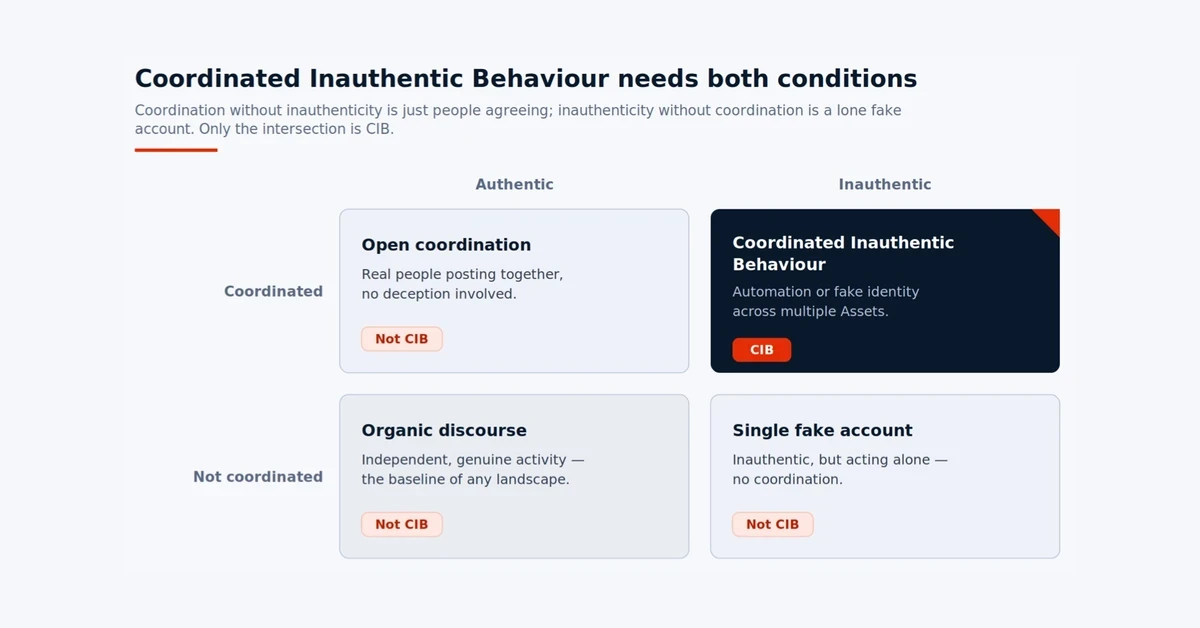
Imagine a scenario: hundreds of posts appear overnight across X and WhatsApp claiming that a major bank is on the verge of collapse. It looks like panic. But the accounts spreading these claims are new, the phrasing is near-identical across languages, and the post timing is concentrated into a 90-minute window. These are the telltale signs of a campaign to weaponize information against an organization.
Spotting these behaviours is at the heart of Narrative Intelligence, a discipline that seeks to explain who is shaping a narrative, how they're doing it, and what action they're engineering their audience to take.
Read the full report here.
As the Narrative Intelligence Framework puts it:
"A single inflammatory post from a real, unaffiliated account is content; the same claim seeded across thirty fresh accounts within an hour, in three languages, with near-identical phrasing, is behaviour, and behaviour is what the framework is built to record."
The Narrative Intelligence Framework describes how LetsData approaches detection, covering everything from how individual accounts are tracked and scored to how isolated incidents compile into a full influence operation.
What's inside
Why behaviour, not content, is the right unit of analysis for detecting influence operations
The knowledge graph model: how narratives, assets, incidents, and operations connect as a structured record rather than a pile of observations
The Narrative, Sub-Narrative, and Trigger hierarchy, and why refuting a single claim rarely defeats a coordinated effort
How the framework handles attribution when it can be established, and stays useful when it cannot
Three worked scenarios: a pre-election operation, an investment fraud campaign, and a case that stays deliberately inconclusive
Read the full report here.