Home / Resources / Case Studies /…
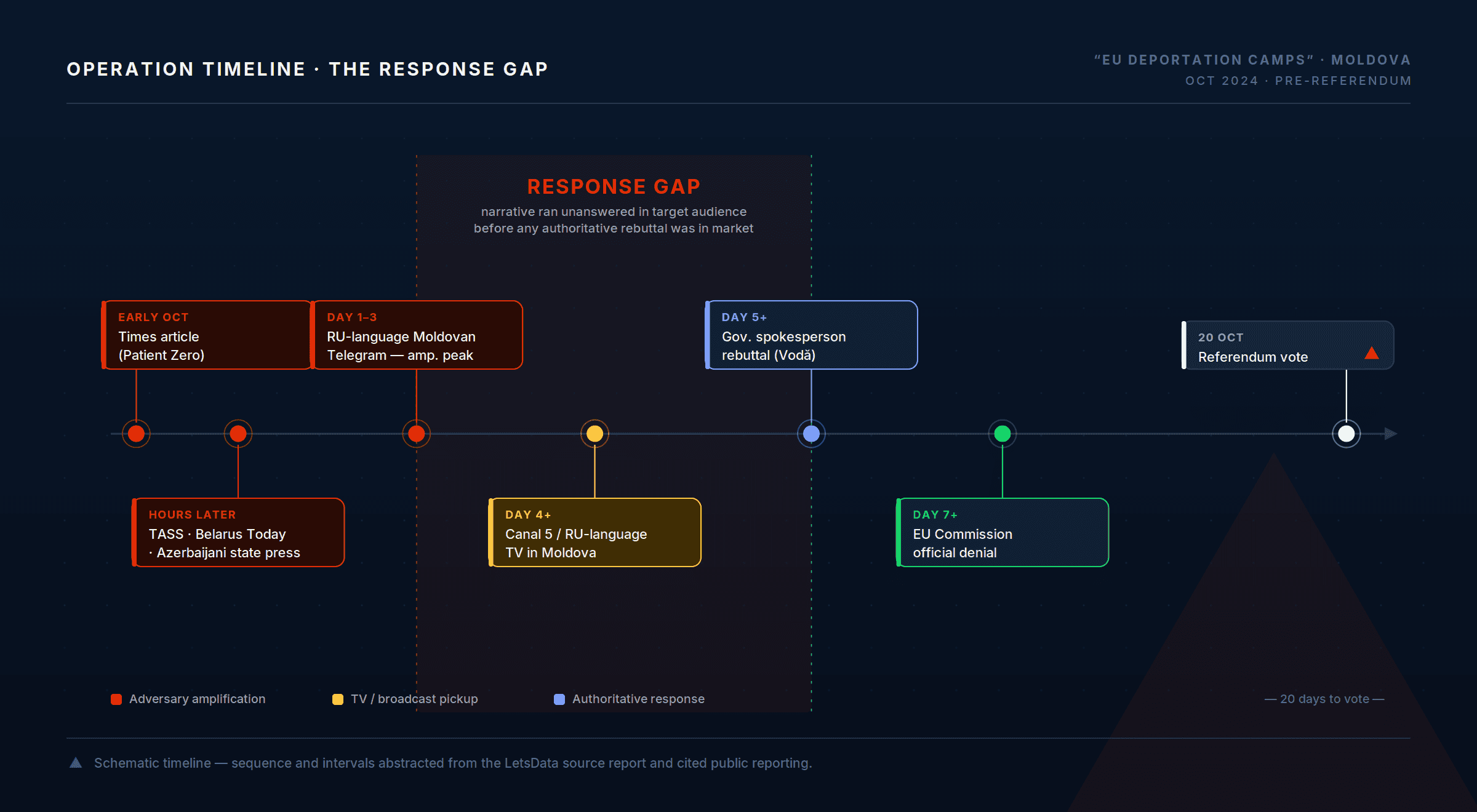
In October 2024, a single newspaper item about “EU deportation camps” moved from a UK paper to Russian state media to Moldovan Russian-language Telegram in days. It became a narrative the Moldovan government had to rebut at the presidential level, in the two weeks before a knife-edge EU membership referendum.
Case Study · Window analysed: approximately 7–20 October 2024
Terms used in this case study
|
Summary
In early October 2024, a UK newspaper article became the spine of a coordinated pre-referendum Sub-Narrative in Moldova — translated, stripped of its qualifying language, laundered through Russian state media, and amplified through Moldovan Russian-language Telegram channels in the two weeks before a knife-edge EU membership vote. Vantage records this kind of activity as an Influence Operation built on opportunistic redirection of weakly-sourced Western press, not on fabricated content. The strategic variable is response timing, not content provenance — and Moldova’s response, while factually correct, came after the frame had already landed.
Operation type | Opportunistic amplification of a weakly-sourced international press item, redirected into pre-existing pro-Kremlin narrative infrastructure as part of a broader election and referendum interference campaign. |
Target country / event | Republic of Moldova — 20 October 2024 presidential election first round and EU membership referendum. |
Window analysed | Approximately 7–20 October 2024 (acute phase); originating press item early October; amplification peak in the two weeks before the vote. |
Primary platforms | Telegram (dominant); Russian-language TV in Moldova (notably Canal 5); Russian state media (TASS, Belarus Today); cross-platform spread on Facebook and TikTok. |
Patient Zero | The Times (UK), early October 2024 — an article citing a single European diplomat on EU “deportation camps” in candidate countries [1]. |
Documented Russian spend on the broader Moldova interference campaign | Approximately €14M funnelled to ~130,000 Moldovans through direct payments; Chișinău estimated total Russian spending on the interference campaign at up to €100M [2]. |
Referendum outcome | EU membership referendum passed by a margin of a few hundred votes [2]. |
Context
The originating press item
In early October 2024, UK outlet The Times published an article — billed as an exclusive and citing a single European diplomat — that said the EU “will set up deportation camps in neighbouring countries that want to join the bloc, such as Serbia, Albania and Moldova.” The article was picked up almost immediately by state-owned outlets including Russia’s TASS, Belarus Today, and Azerbaijani state press, triggering a flood of coverage in Russian-language outlets in Moldova, where approximately 15% of the population are native Russian speakers [2]. EU Home Affairs Commissioner Ylva Johansson confirmed there was no proposal to establish deportation hubs, and European Commission spokesperson Anita Hipper told RFE/RL that claims the EU intends to create deportation camps for migrants in Moldova or other candidate countries are false [3].
The referendum stakes
The narrative landed in the middle of the most consequential two weeks in recent Moldovan political history. Moldovan authorities later documented that approximately €14 million in Russian funds were funnelled directly into the accounts of around 130,000 Moldovans as part of an effort to buy anti-EU votes, with Chișinău estimating total Russian spending on the interference campaign as high as €100 million [2]. The EU referendum ultimately passed by a margin of a few hundred votes.
What we found
Narrative redirection, not narrative creation
The Times article was real journalism, weakly sourced to a single European diplomat, that in a normal information environment would have been a minor three-day story. The pro-Kremlin ecosystem’s contribution was not to fabricate the claim but to redirect it — strip the “discussions” qualifier present in the original, translate into Russian and Romanian, layer it onto pre-existing EU-anxiety Sub-Narratives, and push it through Assets optimised for pre-referendum amplification.
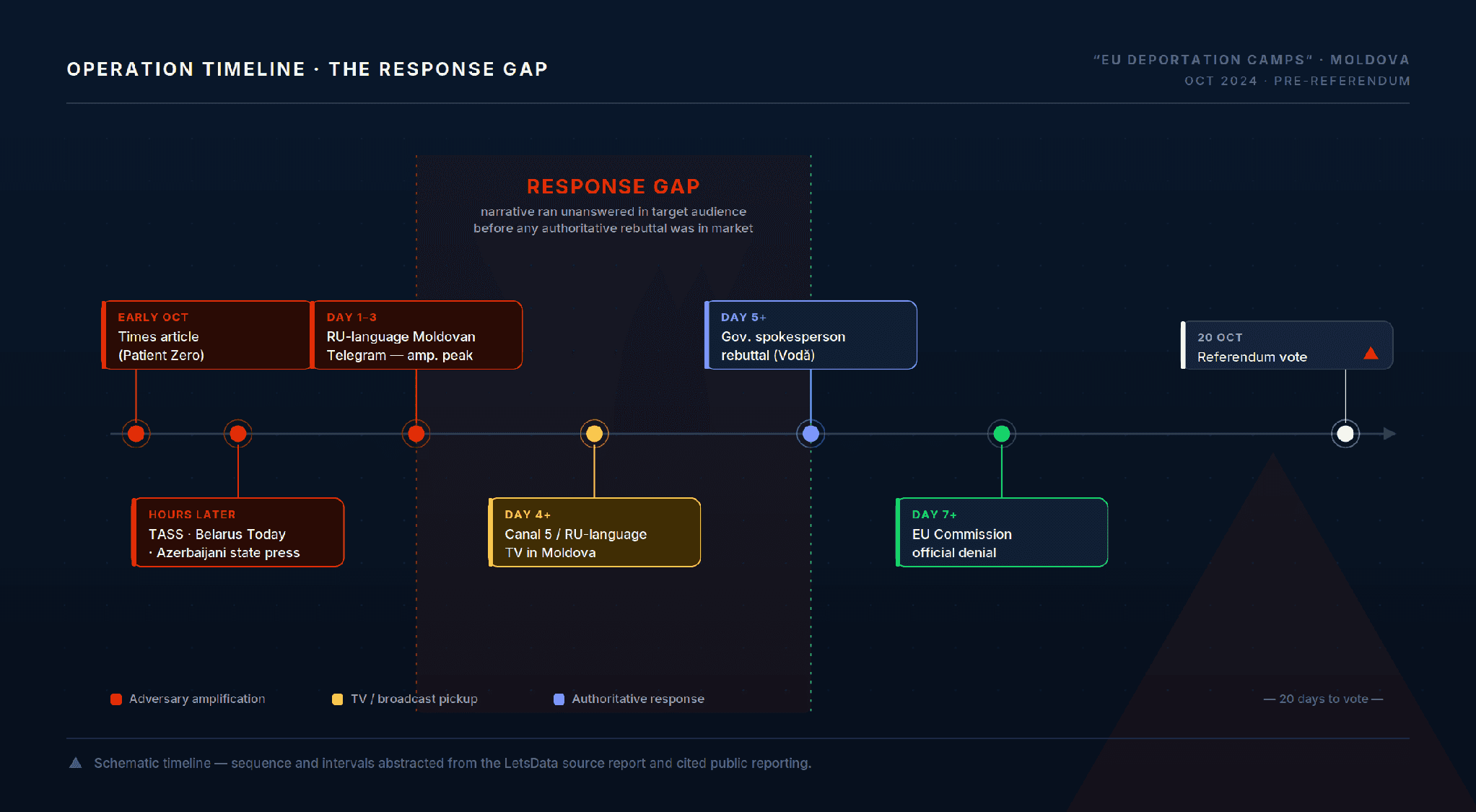 Figure 1. The 24–48-hour response gap between Patient Zero and the first authoritative rebuttal is the load-bearing finding of this case. |
The timing gap, visualised against the referendum date, is the case study’s central artefact.
State-media laundering chain
TASS, Belarus Today, and Azerbaijani state press functioned as a laundering layer between The Times and Moldovan Russian-language Assets. An origin story of “reported in international press” gave the Sub-Narrative a credibility layer that Telegram-seeded disinformation typically lacks [3].
Telegram chatbot as paid-amplification infrastructure
A particularly insidious tactic involved a Telegram chatbot offering financial incentives for disseminating anti-EU content — exploiting economic vulnerability to build what amounts to an unwitting distributed amplification workforce [4]. This is operational infrastructure, not a behavioural signal that appears in content analysis: a content-monitoring tool reads the resulting posts as sincere user activity; a behavioural-detection tool sees the cadence and structure of the chatbot’s output.
Broader campaign context
The Moldova 2024 operation adopted a more overt approach than prior Russian campaigns, openly using official channels (including the Russian Ministry of Foreign Affairs and state-controlled outlets such as TASS and Sputnik Moldova), alongside AI-generated content, document forgery, “false fact-checking” initiatives designed to undermine genuine debunking, and information suppression. Authorities assessed that training camps were used to instruct Moldovan nationals in methods intended to destabilise the country, with Telegram channels used to recruit and pay people to spread content [4][5].
The response gap is the finding
Moldovan government spokesperson Daniel Vodă debunked the reports on Telegram, and the EU’s denial came via official statements. But the rebuttals followed the amplification rather than preceded it — the window between Times publication and Russian-language Moldovan pickup closed before any government-level rebuttal was in market [3].
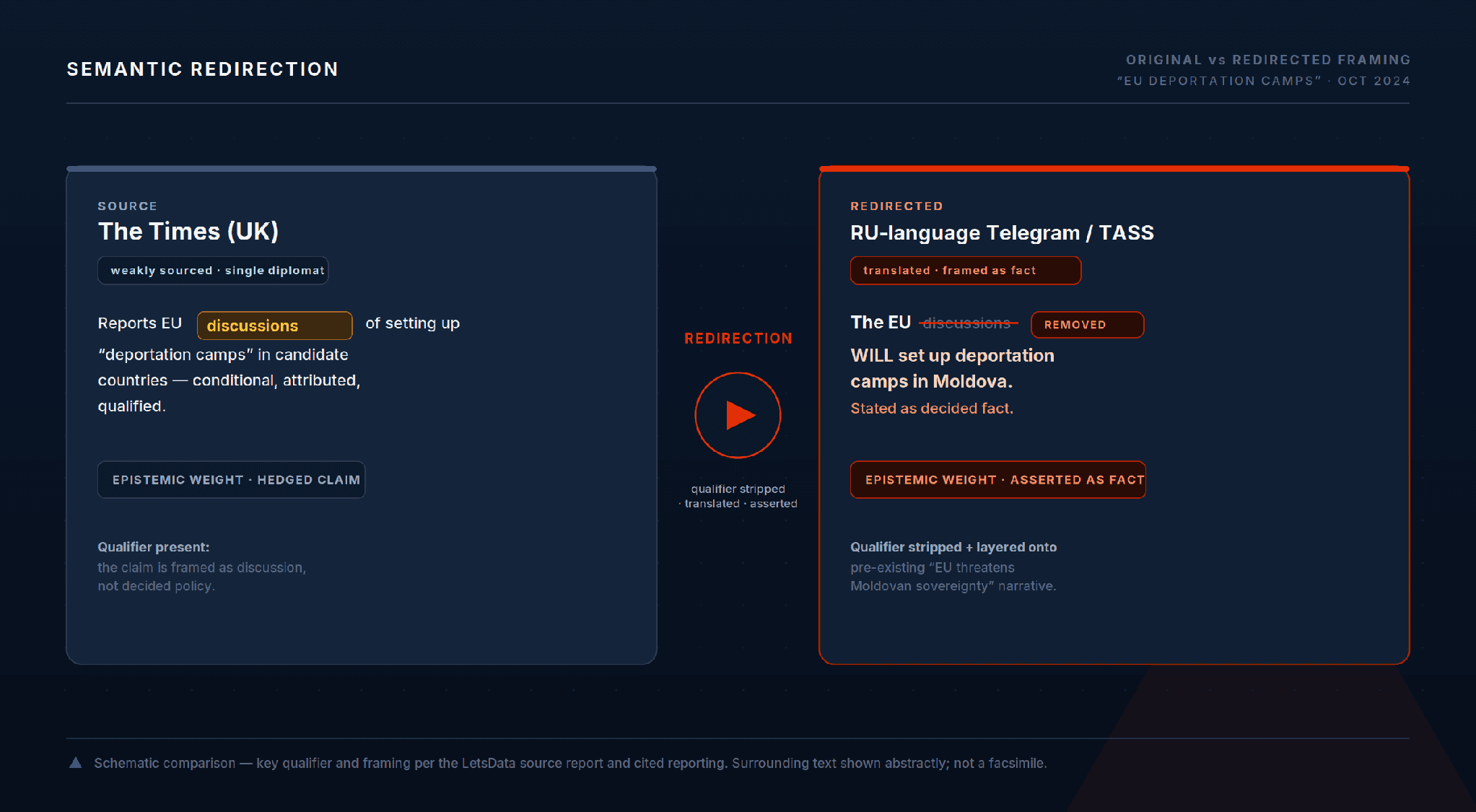 Figure 2. The contribution of the operation is in the redirection, not in the source. |
Analysis — what this means and why it matters
Weak source, strong amplification — the dominant operator pattern now
The deportation-camps episode is a cleaner example of modern Russian Influence Operations than the fabricated-from-scratch operations of the prior decade. The operator does not need to invent — Western press generates enough ambiguous, weakly-qualified material to serve as raw input, and the value-add is translation, redirection, and saturation. Detection approaches that focus on fabricated content miss this mode entirely. The behavioural-detection contribution is tracking the redirection — the Russian-language version that dropped the qualifier, the TASS pickup, the Telegram translation — rather than the original English-language article.
The 24–48-hour window is the trust window
The Moldovan government’s eventual denial was correct on facts, clear on framing, and delivered by the right spokesperson. It still did not close the trust gap opened by the initial amplification. In the pre-referendum environment, every day the narrative ran unanswered in Russian-language Moldovan media compounded — by the time Vodă and the Commission issued their statements, the frame had been absorbed into the broader “EU threatens Moldovan sovereignty” narrative cluster and detached from its originating claim. The lesson is not that the response was bad; it is that response timing is a strategic variable and must be organised to operate on the cycle the adversary operates on.
The close margin makes the counterfactual unknowable but not irrelevant
The referendum passed by a few hundred votes. It is impossible to say which Narratives swung which voters, and responsible analysis resists the temptation to assign causal weight to any single frame. The contribution of behavioural detection is not to adjudicate counterfactuals; it is to ensure that the next close referendum does not lose the response-timing race for the same structural reasons. The Sub-Narrative infrastructure that carried “EU deportation camps” in October 2024 is still standing — and is reusable against the next equivalent Western press item, in Moldova or in any candidate country with a comparable Russian-language audience.
Footnotes
[1] The Times (UK), exclusive citing a European diplomat on EU “deportation camps,” early October 2024.
[2] Calls for offshore EU asylum processing centres fuel misinformation in Moldova, Euronews, 21 October 2024 (https://www.euronews.com/my-europe/2024/10/21/calls-for-offshore-eu-asylum-processing-centres-fuel-misinformation-in-moldova).
[3] Moldova: deportation hubs EU, Radio Free Europe / Radio Liberty, October 2024 (https://www.rferl.org/a/moldova-deportation-hubs-eu/33156187.html).
[4] Moldova as a case study in the amplification of Russian disinformation, DISA (Disinformation Situation Awareness) (https://disa.org/moldova-as-a-case-study-in-the-amplification-of-russian-disinformation/).
[5] The summit on a disinformation mountain, EUvsDisinfo (https://euvsdisinfo.eu/the-summit-on-a-disinformation-mountain/).