Home / Resources / Case Studies /…
The final installment of a five-city Ukrainian mural sequence — Vienna, Berlin, Marseille, Brussels, Nairobi — as an anchor case for measuring what cultural diplomacy accomplishes in environments contested by adversary information operations. Why narrative durability, not launch-day favourability, is the right success metric.
Case Study · Coverage window: mid-March 2023 acute, with sustained tail through September 2023
Terms used in this case study
|
Summary
Cultural diplomacy initiatives generate organic public reception, organic critical response, and — when conducted in environments contested by adversary information operations — sometimes engineered counter-narratives intended to reframe the initiative’s meaning. Reception monitoring exists to separate these three signal types and produce an honest assessment of how an initiative actually landed, rather than the assessment the sponsoring institution would prefer to read. Vantage applies the same data model to this work as to adversary detection — Assets, Publications, Narratives, an Information Landscape scoped by audience — but the question is different: what was the realised public-narrative outcome of an intentional initiative?
Engagement type | Public reception and media engagement monitoring of a Ukrainian cultural diplomacy initiative in a sub-Saharan African capital — applying behavioural-detection infrastructure to a non-adversary measurement question. |
Engagement geography | Kenya — Nairobi (Phoenix House, Muindi Mbingu Street); secondary spillover into Pan-African and Russophone-Africa media spaces. |
Coverage window | Approximately mid-March 2023 acute window, with sustained tail through the Ruto–Zelensky UNGA meeting in September 2023 and into the broader Ukraine–Africa diplomatic outreach period. |
Monitoring scope | Sentiment analysis across Kenyan media · Pan-African media spread tracking · counter-Narrative detection · Russophone-Africa spillover monitoring · diaspora and diplomatic reception. |
Principal counter-Narrative Actors | Specific findings sit in the LetsData source report. Public-record reporting indicates the broader Ukrainian Africa-outreach campaign is one front in the Russia–Ukraine narrative competition for African audiences, with Russian state media and Russian-aligned commentators operating actively in this space. |
Primary platforms monitored | Kenyan English-language press (The Star, Capital FM, Standard Media); Pan-African aggregators (allAfrica, The Guardian Nigeria); diplomatic and embassy communications; X (Twitter); relevant Telegram channels and TikTok in Russophone-Africa adjacent spaces. |
Context
The initiative
On 16 March 2023, the Ukrainian Institute and cultural development agency Port unveiled “Grains of Culture” — the final installment of a five-mural sequence following Vienna, Berlin, Marseille, and Brussels — at Phoenix House in Nairobi. The mural was a collaboration between Ukrainian artists Nikita Kravtsov, Andrii Kovtun, and Alina Konyk and Kenyan artists Paul Kelemba, Moha Graphix, and Eliamin Ink, exploring three themes: the colonial past and post-colonial roles, the collapse of empires, and national identity and resilience — with coffee and wheat grains used as symbols of the political, economic, and diplomatic relationship between the two countries [1].
The strategic framing the sponsor invoked
The Ukrainian Institute and Port positioned the broader project explicitly as a counter-cultural response. In the words of Ukraine’s Deputy Foreign Minister Emine Dzhaparova: “the murals are our response to Russian brutal aggression on the cultural front in the civilizational war which Putin has launched. The policy of destruction and elimination of Ukrainian identity is one of Russia’s key elements in the war against Ukraine.” The Nairobi installation was therefore not just a cultural exchange — it was a cultural diplomacy initiative in a region where Russia has actively contested African opinion, and reception monitoring has to take that adversarial backdrop seriously without conflating it with the reception itself [2].
What we found
The detailed sentiment, channel, and counter-Narrative findings sit in the LetsData source report. The structural patterns surfaced in the analysis are below.
Official-channel reception was positive and broadly aligned
Coverage in The Guardian (Nigeria), allAfrica, Capital FM, The Star, and Tuko consistently framed the project as Ukrainian–Kenyan cultural collaboration with positive valence; the Embassy of Ukraine in Kenya, Nairobi City County, the Goethe Institute, and Phoenix House all backed the launch event publicly [3].
The themes were consciously chosen for cross-cultural resonance
The framing of “rejecting the legacies of war and colonialism” and Kenya’s experience offering Ukraine “valuable lessons” as it seeks to reclaim national identity post-conflict was deliberate alignment of Ukrainian and Kenyan post-colonial Narratives — a high-quality cultural-diplomacy framing that was visible in subsequent media coverage and at the September 2023 Ruto–Zelensky UNGA meeting [4].
The grain symbolism connected to a real diplomatic deliverable
The Ukrainian ambassador announced at the launch event that a ship carrying 25,000 metric tonnes of grain would dock at Mombasa port in October, as part of a planned five-million-tonne delivery to African countries before year-end. The mural reception window therefore overlapped with a tangible material narrative — Ukraine as African food-security partner, contra Russian framings of grain weaponisation — that monitoring tracked alongside cultural reception itself [5].
Counter-Narrative pressure on this class of initiative is documented at the regional level
Reception of Ukrainian outreach in Africa operates against a backdrop of active Russian narrative operations targeting the same audiences. The specific counter-content (if any) targeting Grains of Culture, and the spread and engagement asymmetries between positive and counter framings in Kenyan and Pan-African digital spaces, is what the LetsData source report measured.
Diaspora and diplomatic reception was instrumented around recurring touch points
The September 2023 Ruto–Zelensky UNGA meeting was a downstream activation point for the cultural-diplomacy investment; subsequent commentary by Ukrainian Institute staff explicitly tied Grains of Culture into the broader bilateral trajectory, providing reception-monitoring durations well beyond the immediate launch window [4].
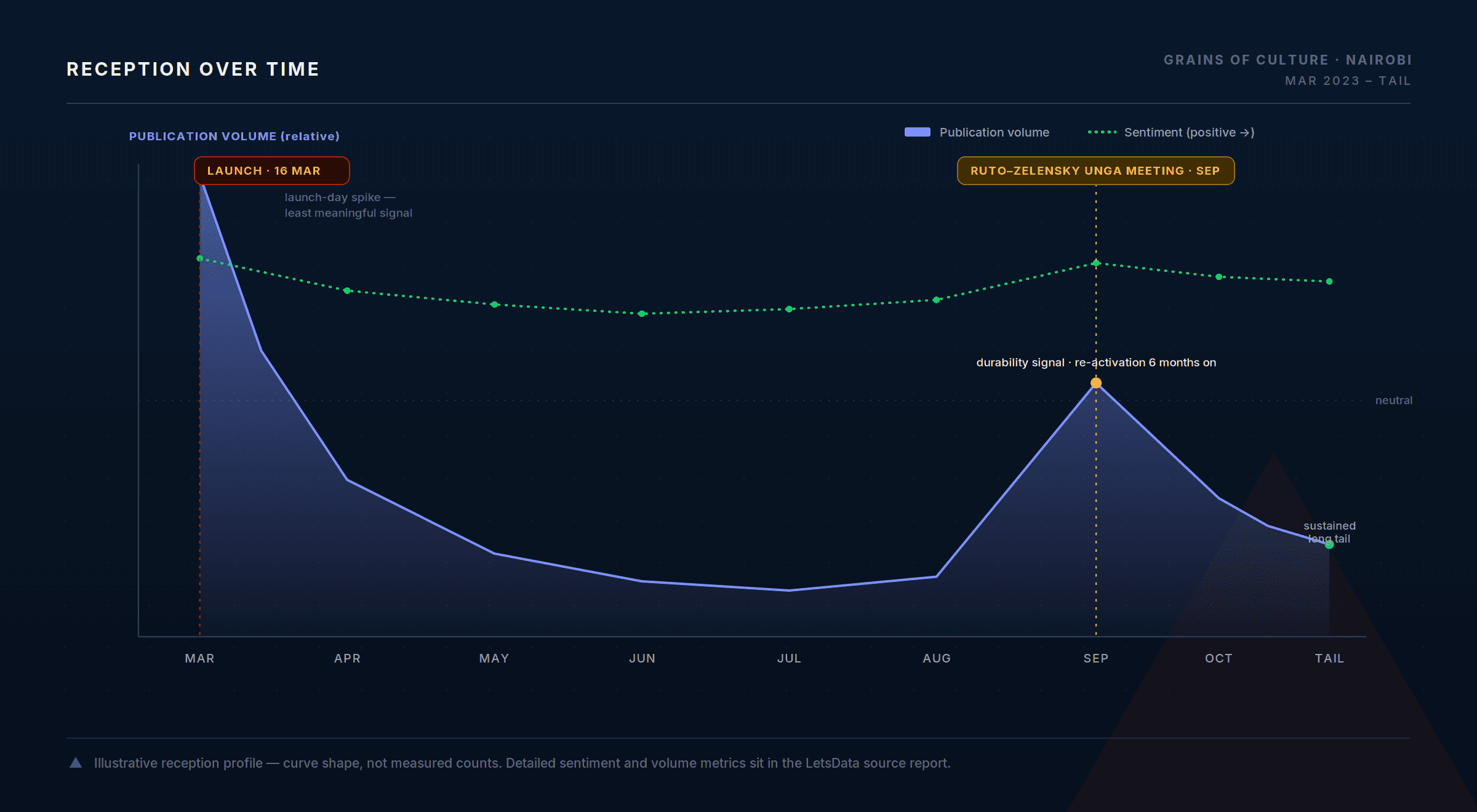
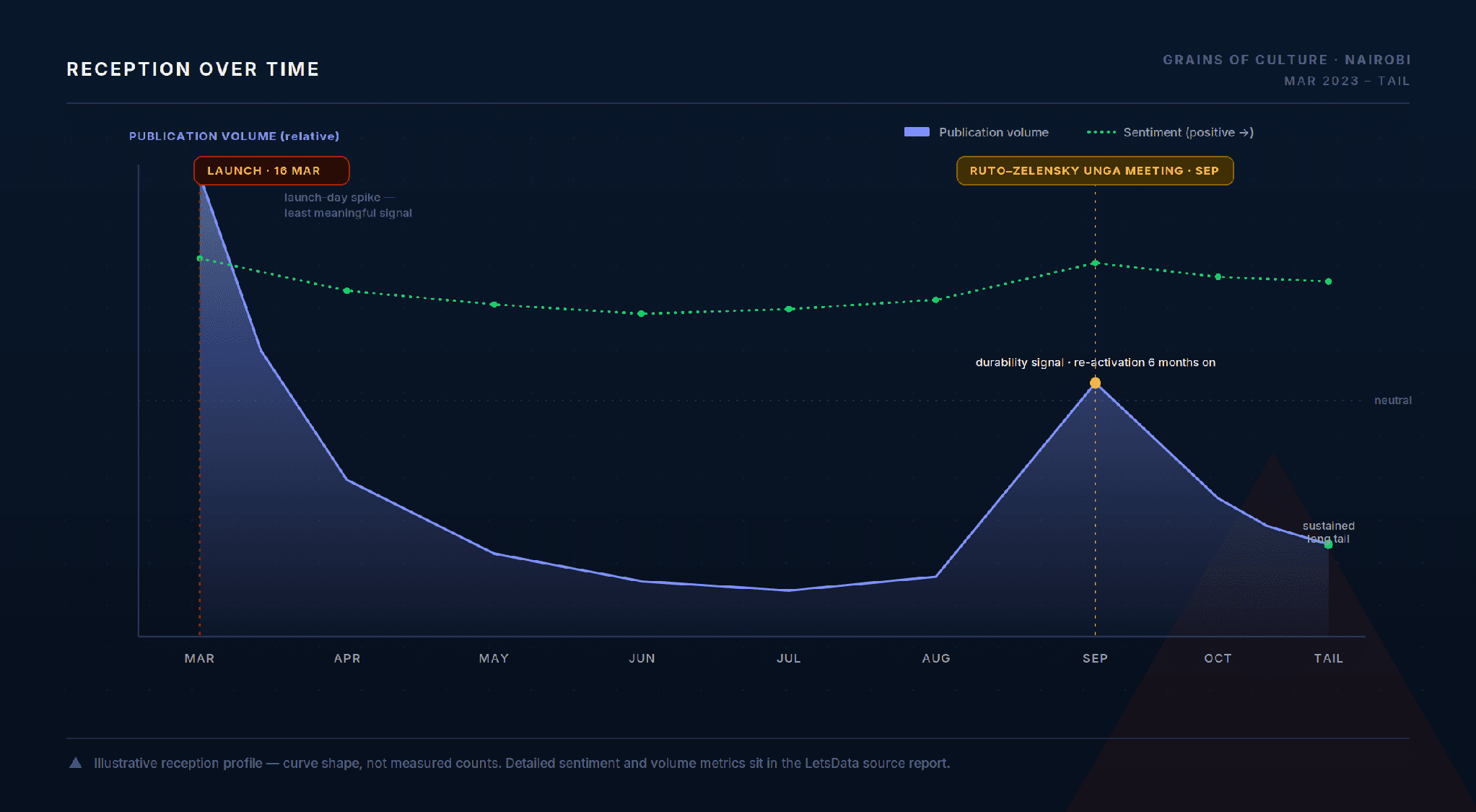 Figure 1. Reception over time, not at launch, is the meaningful success metric. |
Analysis — what this means and why it matters
Reception monitoring is methodologically distinct from adversary detection
Reception monitoring asks: what was the realised public-narrative outcome of an intentional initiative? Adversary detection asks: what was the realised public-narrative outcome of a deceptive operation? These are sister methodologies, but they are not the same thing. Conflating them produces both false-positive findings (treating organic critical reception as adversary action) and false-negative findings (treating adversary-aligned amplification as organic reception). The monitoring product for cultural diplomacy is more useful when explicitly bounded as reception-only, with adversary detection as an opt-in sub-product where the contested-environment backdrop warrants it.
Cultural diplomacy is a long-cycle investment with measurement challenges this work is positioned to address
A single mural in a single capital does not move bilateral relations. What moves bilateral relations is the cumulative effect of dozens of touch points across years, only some of which produce measurable signal. Reception monitoring’s contribution is identifying which touch points actually produced second-order media engagement, diplomatic activation, or narrative re-use — so that subsequent investments can be directed toward higher-yield formats. The Grains of Culture installation is a useful anchor case for this measurement layer because it sits in a recognisable sequence (Vienna, Berlin, Marseille, Brussels, Nairobi) that allows comparative measurement across geographies.
The right success metric is narrative durability, not favourability
Initial reception of a cultural-diplomacy event is almost always positive — opening events draw favourable coverage by construction. The analytically meaningful question is whether the framing persists three months later, six months later, eighteen months later, and whether it gets picked up in adjacent contexts — subsequent diplomatic meetings, food-security discussions, the broader Ukraine–Africa narrative. The Ruto–Zelensky meeting six months after the mural launch is a downstream durability signal; cultural-diplomacy reception monitoring is most valuable when it tracks that long-tail spread rather than launch-day sentiment.
Footnotes
[1] Africa: ‘Grains of Culture’ — Ukrainian-Kenyan mural project unveiled in Nairobi, allAfrica.com, March 2023 (https://allafrica.com/stories/202303100206.html).
[2] Africa: Ceremonial opening of the ‘Grains of Culture’ mural, allAfrica.com, March 2023 (https://allafrica.com/stories/202303160065.html).
[3] In Nairobi, the ceremonial opening of the ‘Grains of Culture’ mural created jointly by artists from Ukraine and Kenya took place, The Guardian (Nigeria) / APO Press Releases (https://guardian.ng/apo-press-releases/in-nairobi-the-ceremonial-opening-of-the-grains-of-culture-mural-created-jointly-by-artists-from-ukraine-and-kenya-took-place/).
[4] Ukraine and Kenya embrace art to confront legacies of war and colonialism, Capital FM, March 2024 (https://www.capitalfm.co.ke/news/2024/03/ukraine-and-kenya-embrace-art-to-confront-legacies-of-war-and-colonialism/).
[5] Ukraine to deepen ties with Kenya through art, The Standard (Kenya) (https://www.standardmedia.co.ke/business/business/article/2001469164/ukraine-to-deepen-ties-with-kenya-through-art).