Home / Resources / Case Studies /…
During the 8th European Political Community (EPC) Summit on 4–5 May 2026, Russian Telegram channels mirrored content into Armenian-targeting feeds at machine speed. Pre-event seeding, verbatim relay, and what the same architecture means for the 7 June parliamentary vote.
Case Study · Window analysed: 29 April – 6 May 2026
Terms used in this case study
|
Summary
On the morning of 3 May 2026, the Russian-language Telegram channel Caucasar posted a Publication framing Volodymyr Zelensky’s Yerevan visit as a cruel joke on Armenian Prime Minister Nikol Pashinyan. Thirty-two seconds later, Rybar reposted it. Within the next minute, two further Armenian-targeting channels had copy-pasted it with a one-second gap between them. Vantage tracked this and 793 other summit-related Publications across the Russian and Armenian Information Landscapes during the 8th EPC Summit (4–5 May 2026), and found a sustained cross-border architecture between sanctioned Russian-attributed Assets and Armenian-targeting channels — moving content at machine speed.
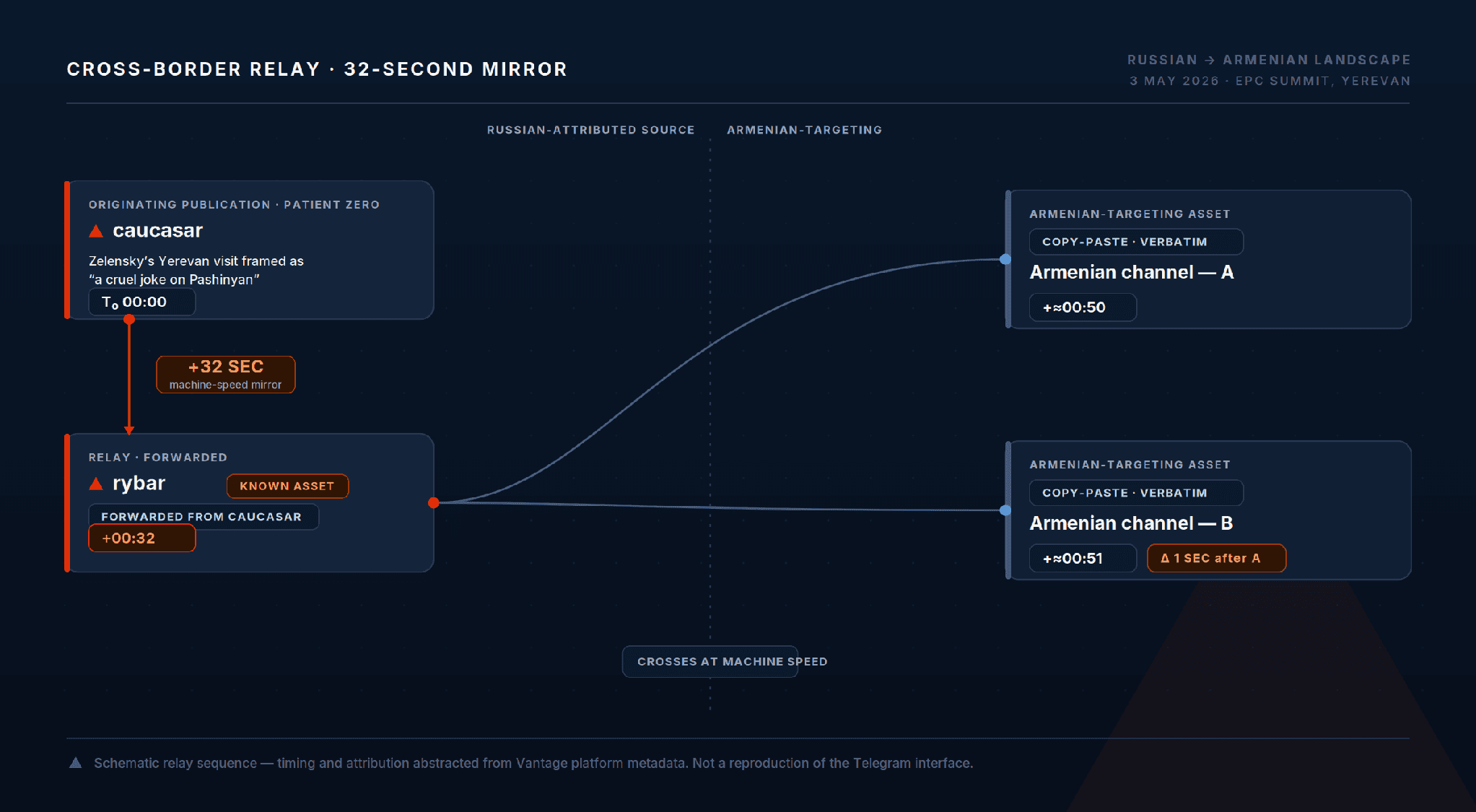 Figure 1. The 32-second mirror between caucasar and rybar — and the near-instant copy-paste into Armenian-targeting channels — is the load-bearing artefact of the case. |
Rybar is what Vantage classifies as a Known Asset — an Asset whose documented behavioural track record warrants elevated scrutiny. The US State Department offered up to $10 million in October 2024 for information identifying Rybar’s operators [1]. Its co-owner Mikhail Zvinchuk is designated under EU Council Implementing Regulation (EU) 2023/1216 for his role in President Putin’s mobilisation working group [2]. Rybar is funded by Rostec, the Russian defence conglomerate sanctioned by the US Treasury in 2022 [3]. The UK sanctioned Rybar LLC and Mikhail Zvinchuk in December 2025 [4].
The alert Vantage triggered on this cluster came from three distinct signals firing together: Rybar’s engagement (as a Known Asset) with a Narrative under active tracking, the posting pattern, and the migration of the Narrative from Telegram channels targeting Russians to those targeting Armenians in Russian language. Vantage tracked the Russian and Armenian Information Landscapes across Telegram, Facebook, YouTube, TikTok, X, and digital media for the period 29 April – 6 May 2026.
Operation type | Cross-Landscape verbatim relay between sanctioned Russian-attributed Assets and Armenian-targeting Russian-language channels, organised around a high-visibility political event and overlapping with a pre-election window. |
Target country / event | Republic of Armenia — 8th European Political Community Summit, Yerevan, 4–5 May 2026; carrying into the 7 June 2026 parliamentary election cycle. |
Window analysed | 29 April – 6 May 2026 (8 days, including pre-event seeding window). |
Primary platform | Telegram (dominant); cross-platform monitoring across Facebook, YouTube, TikTok, X, and digital media. |
Source Assets (sanctioned) | Rybar — pro-Kremlin Telegram outlet, ~1M followers, Known Asset — and Caucasar, its Caucasus-focused affiliate channel; plus high-reach Russian Telegram channels including sashakots. |
Key behavioural finding | 32-second mirror between Caucasar and Rybar; one-second gap between subsequent Armenian-targeting reposts; verbatim distribution architecture observed across more than 89 Russian-language channels in the Russian Landscape. |
Volume | Approximately 11.8 million views across 794 Publications on 4–5 May (Medvedev-anchored and drone-parade Sub-Narrative clusters combined). 22% of summit-related Known Asset reach in the Armenian Landscape was deployed on 2–3 May, before the summit had formally begun. |
Sanctions status of source Assets | Rybar sanctioned by the UK (Dec 2025) [4]; co-owner Mikhail Zvinchuk under EU sanctions [2]; US State Department $10M Rewards for Justice (Oct 2024) [1]; funded through Rostec, US Treasury–sanctioned defence conglomerate [3]. |
Russia: Medvedev as anchor, copy-paste as architecture
Dmitry Medvedev, Deputy Chairman of the Russian Security Council, posted the phrase that became the spine of summit-related Sub-Narratives — “two brainless Russophobes,” referring to Zelensky and Pashinyan, alongside derisive commentary on their English.
Within hours, the text was shared across more than 89 Russian-language Telegram channels. State media outlets carried it as quoted commentary. Military bloggers in the “Z community” reposted it without modification. Secondary aggregator channels propagated it as content. No narrative refinement, no contextual adaptation. The text moved by volume.
A second cluster — reframing Zelensky’s drone-parade statement at the summit as an implicit threat against the 9 May Victory Parade — followed the same logic, with a master text amplified verbatim. The most-reposted variant came from sashakots, a high-reach pro-war Telegram channel. The two clusters together produced approximately 11.8 million views across 794 Publications on 4–5 May.
The behaviour in the Russian Landscape is broadcast: verbatim distribution, anchored on attributed state principals, across a captive Russian-language audience primed by years of contested information environment. The repost structure is the message — this is the state-aligned consensus, and 89 channels are saying it identically.
Armenia: the host Landscape, with cross-border architecture
Armenia is where the cross-Landscape behaviour gets specific. Two findings carry the section.
Pre-summit seeding
22% of total summit-related Known Asset reach in the Armenian Landscape was deployed on 2–3 May — before the summit had formally begun. 967 Publications generating 1.66 million views. These are interpretive baselines established in advance of the event they would later be used to frame.
Cross-border architecture between specific Asset clusters
The Caucasar / Rybar 32-second mirror is one example. It implies one of three mechanisms: automated relay between the two channels; a shared operator working both; or pre-coordinated release. The exact mechanism requires Asset-level investigation. What is established: a sustained operational relationship between an Entity-attributed Russian state-aligned Asset (Rybar) and an Armenian-targeting channel. That is a stronger, narrower claim than “coordinated amplification” — and it is the load-bearing finding of the section.
Three further Patient Zero Publications confirm the same architecture:
“Englishwoman has appeared with her strategy in Armenia” — Patient Zero text on the UK–Armenia strategic partnership: reposted across 5 channels including rybar and caucasar, accumulating over 295,000 combined views.
“Maximum provocation” — Patient Zero framing Yerevan as anti-Russian training ground: simultaneously across more than ten channels.
“They threw a pig in” — Patient Zero on Zelensky’s visit: approximately 270,000 views across the channel cluster.
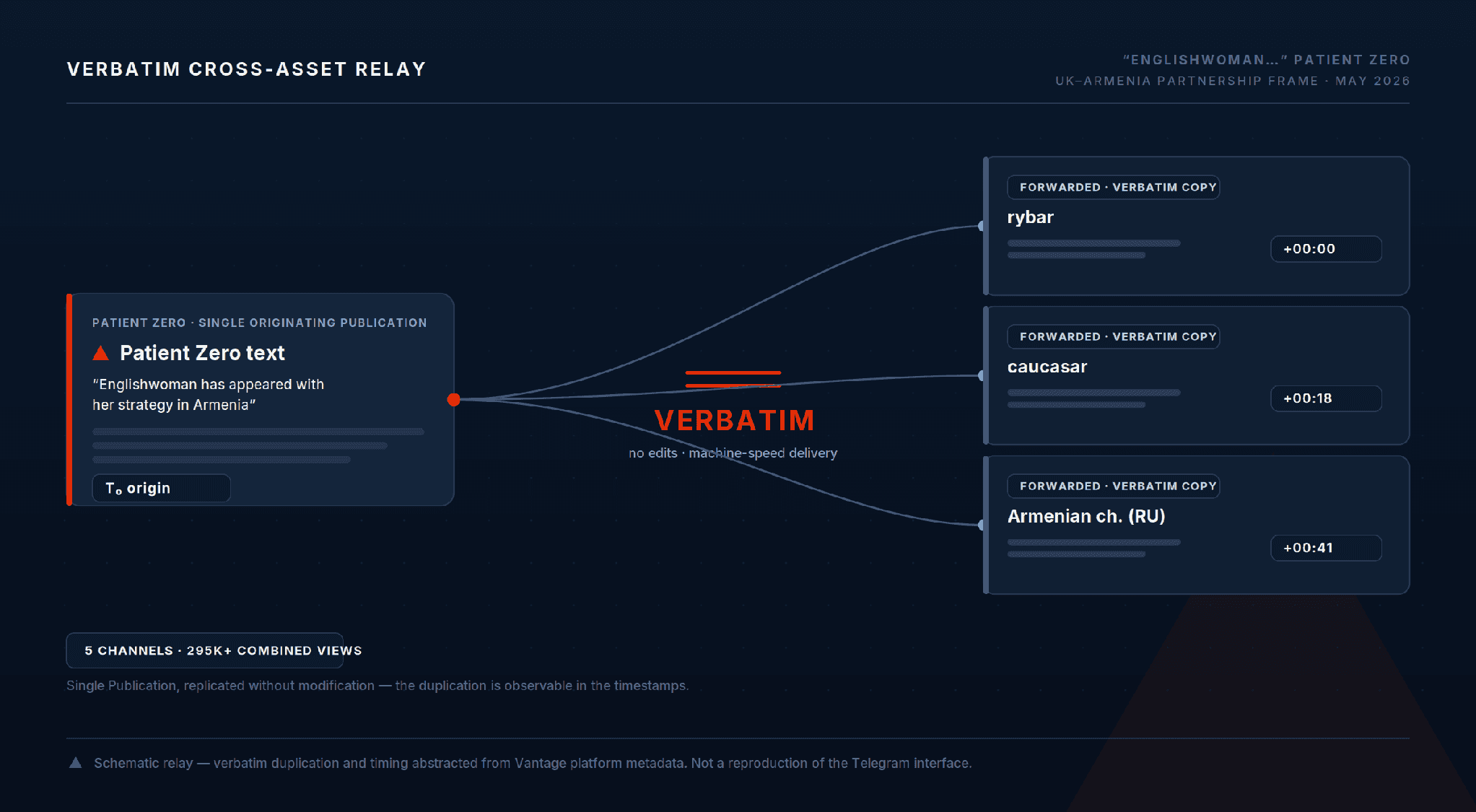 Figure 2. Verbatim cross-Asset relay of a single Patient Zero Publication, observable in the timestamps. |
The most-spread Narrative of the period was Europe’s selective compassion — anchored in Artsakh Human Rights Defender Gegham Stepanyan’s question about why the issue of Armenian prisoners does not bother Europe, and reinforced by a formal ARF Dashnaktsutyun (Hay Dat) statement. It was the most strategically transmissible frame because it sat on real grievances — Karabakh prisoners, post-war trauma, sovereignty concerns. Frames anchored in real concerns moved into neutral coverage in ways fabricated frames did not.
The architecture is different from the Russian Landscape’s. Verbatim distribution exists here too, but it functions as cross-Landscape relay between identified Asset clusters — Russian-language content positioned to penetrate the Armenian Landscape via its Russian-speaking segment. The election context — Armenia’s 7 June parliamentary vote — sits in the background of every pattern observed.
What to watch, and what to act on
For Armenia-focused security teams, the Known Assets that engaged around Yerevan are the ones to monitor around the 7 June parliamentary vote. The cross-border architecture is operational; it does not need to be rebuilt for the election cycle. Specific watch items:
Rybar Publications mirrored into the Armenian Landscape within seconds. The cross-border architecture observed at the EPC Summit is the same architecture available for pre-election content.
New Publication clusters using established frame anchors — Europe’s selective compassion, Selling Artsakh, the Moldovan scenario, sanctions-circumvention as Western coercion. These Sub-Narratives are pre-anchored; reactivation requires no new framing work.
The 22% pre-event seeding figure from the summit window is the baseline against which to read pre-election volume.
Localised re-framings of the same Patient Zero Publication in Armenian language. A shift from Russian-language penetration toward direct Armenian-language amplification would indicate operational adaptation.
The summit-as-trigger pattern observed here is generalisable. Each high-visibility political event in countries with Russian-speaking segments and Russia-aligned Asset clusters is a structurally similar test case. The specific Asset clusters change; the architecture does not. The pre-electoral window in Armenia is the next test in a longer sequence, and what is learned in the next forty days will inform monitoring against the next equivalent trigger after it.
Telegram channel handles referenced
Handles are provided below for reference; analysts wishing to consult them should do so via their own access.
Source Assets (sanctioned / Known Asset)
rybar — Rybar (Known Asset, UK- and EU-sanctioned linkages; US $10M Rewards for Justice)
caucasar — Caucasar (Rybar’s Caucasus-focused affiliate channel)
sashakots — high-reach pro-war Russian-language Telegram channel; carried the most-reposted variant of the drone-parade Sub-Narrative
Note
Additional Armenian-targeting Assets observed in the 32-second mirror sequence and across the broader summit-window cluster are catalogued in the source data and are available on request to authorised analysts.
Footnotes
[1] Rybar Employees, US Department of State — Rewards for Justice, 19 October 2024 (https://rewardsforjustice.net/rewards/rybar-employees/).
[2] Mikhail Sergeevich Zvinchuk, Council Implementing Regulation (EU) 2023/1216 of 23 June 2023; consolidated record via OpenSanctions (https://www.opensanctions.org/entities/Q119234000/).
[3] OFAC press release on Rostec designation, US Department of the Treasury, 24 February 2022 — Cited in Rewards for Justice (footnote 1).
[4] UK sanctions pro-Kremlin Dugin, Rybar, and Pravfond network, OCCRP, December 2025 (https://www.occrp.org/en/news/uk-sanctions-pro-kremlin-dugin-rybar-and-pravfond-network)